
The moment I realized I wasn’t lost came at a time when, by every external measure, I had made it.
I owned my first home on my own. I had a partner and four beautiful stepkids. I was living in a great city, working a high-level corporate job, making mid–six figures. I had friends, family, and a life that looked stable, successful, and full.
And yet, I felt empty.
When my relationship began to fall apart — when my partner, fresh out of a 26-year marriage, realized he didn’t know who he was — everything started to crack. Eventually, he moved out. That was the moment the truth surfaced: I wasn’t heartbroken just because I lost the relationship. I was terrified of being alone. I realized how deeply codependent I had become, how much my sense of worth and meaning was tied to having someone beside me.
I had everything I thought I was supposed to want — and none of it felt like enough on its own.
At the same time, I was caring for my dad, both emotionally and financially. Even with the income I was making, I was barely staying afloat. To make ends meet, I rented out my house and lived in an RV in the dead of winter — no heat, brushing my teeth at work, bringing a change of clothes with me every day, pretending everything was fine while my body and mind were unraveling.
From the outside, I looked successful.
On the inside, I was surviving — again.
The burnout was relentless. The exhaustion was bone-deep. Depression settled in quietly, followed by intense anxiety and panic attacks. My mind had always been resilient, but my body finally said enough. Years of living in survival mode had caught up to me, and everything came crashing down at once.
That’s when I understood something I had never allowed myself to see before: I wasn’t broken. I wasn’t ungrateful. I wasn’t lost.
I was living a life shaped by expectations, responsibility, and survival — not by what actually sustained me.
Taking a leave from work and choosing to focus on healing wasn’t a breakdown.
It was the beginning.
Survival Mode Taught Me Everything — Except How to Rest
Survival mode didn’t arrive suddenly in my life.
It was always there.
It started early — in instability, unpredictability, and learning to read the room before I learned how to read myself. When life doesn’t feel safe, you adapt. You become alert. Capable. Self-sufficient. You learn how to push through discomfort and keep going because stopping doesn’t feel like an option.
For a long time, I thought that made me strong.
And in many ways, it did.
Survival mode taught me resilience. It taught me how to figure things out, how to lead, how to carry responsibility, how to keep moving even when things were heavy. It helped me build a career, manage crises, and rebuild my life more times than I can count.
What it didn’t teach me was how to rest.
Rest felt foreign.
Unsafe.
Unproductive.
Even when things were “good,” my body stayed braced. Always scanning. Always preparing for the next thing to go wrong. I didn’t know how to relax without guilt or anxiety creeping in. Stillness felt uncomfortable. Quiet felt loud.
I mistook constant motion for motivation and exhaustion for dedication.
So I kept going.
I pushed through stress. I ignored the signs. I normalized being tired, tense, and overwhelmed. I told myself this was just what adulthood looked like — what success required. If I slowed down, I felt lazy. If I stopped, I felt like I was falling behind.
The truth was, I didn’t know how to exist outside of urgency.
Survival mode had become my identity.
It wasn’t until my body started pushing back — through burnout, anxiety, panic, and depression — that I realized how long I had been living on overdrive. My mind was still trying to power through, but my nervous system was exhausted. It had been carrying years of unprocessed stress, responsibility, and emotional weight.
Rest didn’t come naturally to me because rest was never modeled as safe.
Slowing down meant feeling things I had learned to avoid. Grief. Anger. Fear. Emptiness. And so I stayed busy instead. Productive. Capable. Needed.
But survival mode isn’t meant to be a permanent state. It’s a response — not a way of life.
Learning how to rest wasn’t about taking a vacation or checking out. It was about learning how to feel safe in my own body again. About listening instead of overriding. About choosing presence over performance.
It meant unlearning the belief that my worth came from how much I could carry.
Rest didn’t make me weaker.
It made me honest.
And honesty was the first step toward living instead of surviving.
The Cost of Being Palatable
I learned early how to make myself easy to digest.
Not too loud.
Not too emotional.
Not too much.
I learned how to read people before I learned how to listen to myself. How to soften my edges. How to anticipate needs. How to adjust so no one felt uncomfortable — even when I was.
At the time, it felt like survival.
In reality, it was self-erasure.
Being palatable meant I was liked. Accepted. Included. It meant I didn’t rock the boat or ask for too much. It meant I was adaptable, agreeable, and dependable. The one who could handle things. The one who didn’t complain.
It worked — until it didn’t.
Because the cost of being palatable is subtle. It doesn’t show up all at once. It shows up slowly, over years, in small compromises you barely notice at first. You say yes when you mean no. You downplay what you want. You swallow reactions. You explain yourself away.
And eventually, you don’t recognize yourself anymore.
I wasn’t pretending — not consciously. I truly believed this was who I was. Helpful. Easygoing. Flexible. Strong. I told myself I didn’t need much. That I was fine. That other people had it worse.
But underneath that version of me was resentment I didn’t know how to name. Exhaustion I couldn’t explain. A quiet anger at how invisible I felt in my own life.
The truth was, being palatable kept me safe — but it never made me fulfilled.
I built relationships where my needs came last. Careers where my value was measured by output, not alignment. A life where I was praised for how much I could carry, not how honest I could be.
And the hardest part?
People liked me for the version of me that wasn’t real.
That realization hurts in a way that’s hard to describe. Because you start to wonder: If I stop being this version, will I still be loved? Will I still belong?
So you keep going. You keep performing. You keep making yourself smaller because the risk of being fully seen feels bigger than the cost of disappearing.
Until your body pushes back.
Until burnout sets in.
Until resentment leaks out in ways you can’t control.
That’s when I realized something I had avoided for a long time:
Being palatable was costing me my voice.
My boundaries.
My truth.
Choosing myself didn’t mean becoming harsh or closed off. It meant becoming honest. It meant allowing discomfort — mine and other people’s. It meant accepting that not everyone would understand the version of me that no longer softened her edges.
And that was okay.
Because the people who only loved the palatable version of me were never really loving me.
Letting go of that version wasn’t graceful. It was uncomfortable. Lonely at times. It required me to sit with guilt and fear and the urge to explain myself.
But it also gave me something I had never had before:
Relief.
I wasn’t constantly managing reactions anymore. I wasn’t translating myself into something easier to accept. I wasn’t betraying myself just to keep the peace.
I wasn’t palatable.
I was real.
And real, I learned, costs less than pretending ever did.
When Love Feels Like Endurance, Not Safety
For a long time, I thought love was supposed to be hard.
Not challenging in the way that helps you grow — but heavy. Draining. Something you worked at relentlessly, even when it cost you pieces of yourself. I believed that staying meant strength and leaving meant failure.
So I stayed.
I stayed in relationships where I felt responsible for holding everything together. Where my needs were negotiable, but my loyalty was expected. Where love felt more like endurance than safety.
At the time, I didn’t question it. It felt familiar. Familiar from watching adults survive relationships instead of feel held by them. Familiar from learning early that love often came with instability, emotional labor, and self-sacrifice.
I mistook anxiety for connection.
I mistook effort for intimacy.
I mistook staying for love.
And because I was so good at adapting, I made it work — at least on the surface. I explained things away. I softened my needs. I told myself this was just what commitment looked like.
But deep down, my body knew the truth long before my mind caught up.
Love that requires you to disappear isn’t love — it’s survival dressed up as loyalty.
When relationships feel like something you have to endure, it’s usually because they’re built on fear: fear of being alone, fear of starting over, fear of disappointing someone, fear of choosing yourself.
Walking away doesn’t make you weak.
Staying misaligned makes you tired.
What I’ve learned — and what I see over and over again in the women I work with — is that many of us aren’t afraid of being alone. We’re afraid of sitting with ourselves long enough to hear what we actually need.
Choosing safety over endurance isn’t selfish.
It’s honest.
And honesty is where real connection begins — with others, and with yourself.
If you’re reading this and something feels familiar — if you’ve been questioning your patterns, your relationships, or why you keep shrinking to make things work — you don’t have to figure it out alone.
This is exactly the kind of work I do in my coaching sessions.
Not fixing you.
Not telling you what to do.
But helping you untangle what’s familiar from what’s healthy, and reconnect with your own truth so your choices come from clarity instead of fear.
If you’re ready to explore that — gently, honestly, and without judgment — you can book a one-on-one coaching session with me. This work isn’t about changing your life overnight. It’s about learning how to stop abandoning yourself inside it.
You deserve relationships that feel safe to exist in — not ones you have to survive.
Burnout Wasn’t My Breaking Point — It Was My Boundary
Burnout didn’t happen because I wasn’t capable enough.
It happened because I didn’t know how to stop.
I had learned to push through discomfort, override exhaustion, and keep going no matter what. Rest always felt like something I’d earn later — after the next milestone, the next responsibility, the next crisis.
But later never came.
Instead, my body stepped in where my boundaries were missing.
The fatigue became constant. The anxiety louder. Panic attacks started showing up without warning. My mind kept insisting I could handle it, but my nervous system was done negotiating.
Burnout wasn’t weakness.
It was information.
It was my body saying: this pace isn’t sustainable anymore.
This way of living is costing you too much.
For years, I had ignored the signals because slowing down felt irresponsible. Because being needed felt safer than being present. Because productivity had become my proof of worth.
Burnout stripped that illusion away.
It forced me to confront a hard truth: no amount of resilience can replace self-respect. And no life is worth living if it requires you to constantly betray yourself to maintain it.
Learning how to listen — really listen — to my body changed everything. I stopped treating rest like a reward and started treating it like a requirement. I stopped seeing boundaries as limitations and started seeing them as protection.
Burnout wasn’t the end of my capacity.
It was the beginning of my clarity.
If you’re here because something in this feels familiar — the exhaustion, the anxiety, the sense that your body is asking you to slow down — you don’t need to have answers yet.
You don’t need to be ready for a big change.
You don’t need to know what comes next.
Sometimes the first step is simply having a space where you don’t have to explain or justify how tired you are.
That’s what my coaching sessions are for.
They’re not about fixing you or pushing you into decisions. They’re about helping you understand what your body and nervous system are communicating, and learning how to build a life that doesn’t require constant burnout to sustain it.
If that feels supportive right now, you can explore working together — quietly, at your own pace.
No pressure. No expectations. Just an invitation.
I Had the Career — I Didn’t Have Myself
From the outside, it looked like I had arrived.
The title.
The salary.
The responsibility.
The validation.
I had worked hard to get there — climbed ladders, earned trust, delivered results. I was respected. Relied on. Seen as capable and dependable. And for a long time, I believed this was proof that I was doing life right.
But somewhere along the way, I stopped checking in with myself.
My calendar was full. My days were productive. My life was impressive on paper. And yet, I felt increasingly disconnected from the person living it. I was showing up everywhere — except for myself.
I told myself this was just ambition. That fulfillment would come later. That feeling empty was the price of success.
But success that costs you your sense of self isn’t success — it’s performance.
I didn’t hate my work. I hated how much of myself I had to suppress to keep functioning inside it. I hated how often I ignored my body. How easily I dismissed my intuition. How normal it became to feel anxious, exhausted, and emotionally numb.
I was succeeding at something that no longer felt like mine.
The hardest part wasn’t walking away from a role or redefining my career — it was admitting that I had outgrown the version of myself who needed external validation to feel safe.
Letting go of that identity felt terrifying. Because when you’ve built your worth around what you do, who are you without it?
What I learned — slowly, imperfectly — is that you don’t lose yourself all at once. You drift. One compromise at a time. One ignored instinct. One “I’ll deal with it later.”
Until one day, later arrives.
Reclaiming myself didn’t mean burning everything down. It meant telling the truth — to myself first. It meant asking different questions. It meant choosing alignment over appearance, even when the answers were unclear.
I didn’t stop working hard.
I stopped working against myself.
And that made all the difference.
Starting Over Isn’t Brave — Staying Misaligned Is Exhausting
Starting over gets a lot of credit.
We call it brave. Bold. Empowering. We romanticize reinvention like it’s a dramatic leap — a clean break, a fresh start, a moment of clarity followed by confidence.
That hasn’t been my experience.
Starting over wasn’t brave for me. It was necessary.
What was exhausting was staying. Staying in roles that no longer fit. Staying in relationships that required me to shrink. Staying in versions of my life that looked right but felt wrong in my body.
Misalignment is loud when you ignore it long enough.
It shows up as restlessness you can’t explain. As irritation over small things. As the constant sense that something is off — even when everything is technically “fine.” You tell yourself you should be grateful. You try harder. You wait for the feeling to pass.
It doesn’t.
Eventually, the cost of staying becomes heavier than the fear of leaving. And that’s usually when change happens — not from courage, but from fatigue.
Starting over didn’t come with certainty or confidence. It came with questions. With grief for the version of me I was letting go of. With fear about disappointing people who were comfortable with who I used to be.
But staying would have meant continuing to abandon myself.
I didn’t burn everything down. I didn’t reinvent myself overnight. I made small, honest shifts — listening more closely, choosing differently, allowing discomfort instead of numbing it.
Starting over isn’t about becoming someone new.
It’s about stopping what no longer fits.
And the truth is, you don’t need permission to change your life. You need honesty. With yourself first.
If you’re standing at the edge of something — unsure, tired, questioning — it doesn’t mean you’re failing. It means you’re paying attention.
That’s not weakness.
That’s awareness.
Healing Isn’t Soft — It’s Uncomfortable and Necessary
Healing is often sold as something gentle.
Bubble baths. Quiet mornings. Deep breaths and positive affirmations. And while those things can be supportive, they’re not the part of healing that actually changes you.
Real healing is uncomfortable.
It asks you to slow down when your instinct is to stay busy. It asks you to feel things you’ve spent years avoiding. It brings up grief for versions of yourself that did the best they could — even when those versions no longer fit.
Healing isn’t about becoming calm all the time. It’s about becoming honest.
For me, healing meant sitting with the parts of myself I had learned to outrun. The anger I didn’t feel allowed to express. The sadness I minimized. The fear that kept me choosing familiarity over alignment.
There was nothing soft about that.
Healing required me to question beliefs that once kept me safe. To let go of identities I had built my worth around. To disappoint people who preferred the old version of me.
And yet, healing wasn’t violent or chaotic either.
It was quiet. Slow. Often invisible.
It happened in the moments I chose to listen instead of override. In the times I stopped explaining myself. In the days I rested even when guilt showed up. In the boundaries I set without knowing how they’d be received.
Healing didn’t fix me.
It reconnected me.
It taught me that discomfort isn’t a sign you’re doing something wrong — it’s often a sign you’re doing something honest. That growth rarely feels good in the moment, but it feels relieving in the long run.
Healing isn’t soft.
But it is necessary.
And it doesn’t require perfection — only presence.
You Don’t Need a New Life — You Need Self-Trust
For a long time, I thought the answer was more change.
A new city.
A new job.
A new relationship.
A new version of myself.
I believed that if I could just rearrange the external pieces enough, something inside me would finally settle.
It didn’t.
What I was really searching for wasn’t a new life — it was permission to trust myself.
Self-trust isn’t loud. It doesn’t arrive as certainty or confidence. It shows up quietly, in small moments where you stop overriding your instincts and start listening instead.
For me, the lack of self-trust looked like second-guessing every decision. Like asking for reassurance even when I already knew the answer. Like staying in situations that didn’t feel right because they made sense on paper.
I didn’t trust myself because, for most of my life, I hadn’t been allowed to. Survival taught me how to adapt — not how to choose. I learned how to read other people, meet expectations, and keep things together. My own voice became background noise.
Rebuilding self-trust didn’t happen through big leaps. It happened through small acts of honesty.
Saying no when my body tightened instead of explaining it away.
Resting before I was completely depleted.
Letting myself change my mind without guilt.
Self-trust grew every time I stopped abandoning myself in the quiet moments.
You don’t need to know where you’re going to trust yourself. You just need to stop telling yourself that your feelings are wrong, inconvenient, or dramatic.
Self-trust isn’t about getting it right all the time.
It’s about knowing you’ll listen to yourself when it matters.
And once you have that, you don’t need a new life.
You need alignment.
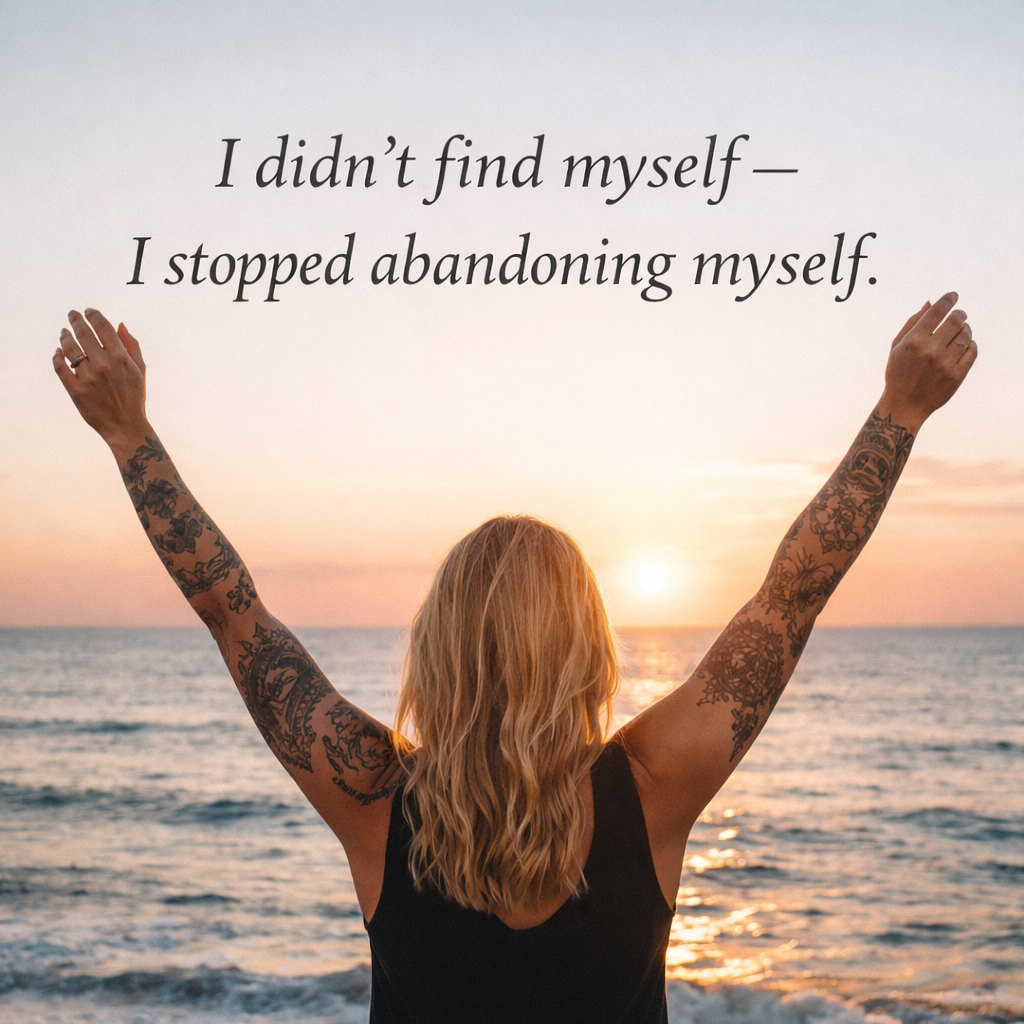
I Didn’t Find Myself — I Stopped Abandoning Myself
For a long time, I thought I was searching for myself.
I said it casually — “I just need to figure myself out.”
As if I was lost somewhere outside of me, waiting to be discovered once I worked hard enough or got things right.
The truth is harder and simpler than that.
I wasn’t lost.
I was leaving myself — quietly, repeatedly, and with good intentions.
Every time I ignored my body.
Every time I stayed silent to keep the peace.
Every time I chose what made sense over what felt true.
None of it was dramatic.
That’s what made it easy to miss.
Abandonment doesn’t always look like walking away. Sometimes it looks like staying — staying busy, staying agreeable, staying functional — while slowly disconnecting from yourself.
Coming back to myself didn’t happen all at once. It wasn’t a moment of clarity or confidence. It was a series of small, honest choices: listening when something felt off, resting without justification, allowing myself to change without explaining why.
I didn’t become someone new.
I remembered who I was before survival taught me to disappear.
This is what living looks like now — not perfect, not always easy, but honest. I still feel fear. I still doubt myself sometimes. The difference is, I don’t abandon myself when those feelings show up.
And that’s the work.
Not chasing.
Not fixing.
Not becoming.
Returning.
If you’ve been walking this path alongside me through this post, I hope you’ve felt less alone. And if you’re just arriving here, know this:
You don’t need to find yourself.
You’re already here.