Author: 807067pwpadmin

  • I Spent My Life Solving Everyone Else’s Problems — Until I Realized I Was the Product

    I Spent My Life Solving Everyone Else’s Problems — Until I Realized I Was the Product

    For most of my life, I didn’t know how to sit still.

    Not because I was restless, but because someone always needed something.
    A solution.
    A plan.
    A next step.

    I was the person people came to when things felt messy. When businesses were stuck. When money wasn’t flowing. When decisions felt overwhelming. I connected dots others couldn’t see yet. I asked the right questions. I built systems, fixed gaps, smoothed chaos, and helped people move forward.

    At the time, I thought that was just who I was. Helpful. Capable. Reliable.

    What I didn’t realize was that I was spending my entire life building value for everyone else — without ever stopping to ask how to build freedom for myself.

    Looking back, the pattern is obvious.

    I helped launch businesses that weren’t mine.
    I guided people through transitions I was too afraid to take myself.
    I helped others make money while telling myself stability mattered more than freedom.

    I was the behind-the-scenes person. The problem solver. The one who made things work.

    And here’s the truth that took me years to accept:

    I was brilliant at creating outcomes.
    I just wasn’t applying that brilliance to my own life.

    Instead, I tied my sense of worth to being needed. To being useful. To being the one who figured things out so no one else had to panic.

    That’s exhausting, by the way. And it slowly disconnects you from yourself.

    For a long time, I thought financial freedom would come from the “right” business.
    The perfect plan.
    The next opportunity.

    I kept searching outside of myself.

    But every time I looked back at my life, one thing was consistent:
    I had already been creating value everywhere I went.

    I wasn’t lacking skills.
    I wasn’t lacking experience.
    I wasn’t lacking insight.

    I was overlooking the obvious.

    I was the product.

    My ability to see the whole picture.
    My ability to guide people through uncertainty.
    My ability to turn confusion into clarity.

    That was the asset.

    Once I saw that, everything shifted.

    It didn’t happen all at once. It never does.

    It happened quietly. In moments where I realized I was doing the same thing again — helping someone else build something while feeling stuck in my own life.

    I asked myself a hard question:

    “What if I stopped trying to become something new and started owning what I already am?”

    That question changed everything.

    Because freedom doesn’t come from starting over.
    It comes from using what you already have — intentionally.

    Here’s what I’ve learned, and what I wish someone had told me sooner:

    • If people constantly come to you for advice, you have value.
    • If you’re the one connecting dots, you have clarity others need.
    • If you’ve helped people build, grow, or navigate hard moments, you already have a skillset.
    • If you feel stuck but capable, the problem isn’t you — it’s how you’re using yourself.

    Most people don’t need more education.
    They need permission to trust what they already know.

    If you’re reading this and feeling like you’re standing at an edge — unsure whether to start a business, change your life, relocate, or finally choose yourself — I see you.

    You don’t need to burn everything down.
    You don’t need to reinvent yourself.
    You don’t need to wait until you’re “ready.”

    You need to recognize your own value.

    You already have something people need.
    You’ve already been doing this work — even if no one ever called it a business.

    If you want something practical to reflect on, start here:

    Ask yourself:

    • What do people consistently ask me for help with?
    • Where do I naturally see solutions others miss?
    • What problems do I solve without thinking twice?
    • Where have I already created results for others?

    Then ask:

    • What would change if I treated this as valuable?
    • What would happen if I built my life around this instead of giving it away?

    You don’t need all the answers yet. You just need to stop ignoring the evidence.

    I help people see what’s already in their hands.

    Whether you’re:

    • Starting a business
    • Considering a relocation
    • Rebuilding after a major life shift
    • Or standing at a crossroads unsure of your next move

    I help you connect the dots, just like I’ve been doing my whole life — but this time, intentionally.

    Freedom isn’t something you chase.
    It’s something you build when you finally see your own worth clearly.

    If this resonates, if you’re tired of solving everyone else’s problems while your own life stays on pause, let’s talk.

    You don’t need more pressure.
    You need clarity.

    And I can help you find it — using what you already have.

    Ready to Stop Giving Your Value Away?

    If this post hit something in you, it’s probably because you’ve been here too.

    You’re the one people come to when things fall apart.
    You see the patterns.
    You connect the dots.
    You solve problems without even trying.

    And yet, when it comes to your life, your direction, your freedom… you feel stuck at a crossroads.

    Here’s the truth most people never tell you:
    What you’ve been doing naturally your entire life is the thing that can create your freedom.
    You don’t need to become someone else.
    You need to finally use what you already are.

    I work with people who are:

    • At a crossroads in life, business, or location
    • Burnt out from building everyone else’s dreams
    • Considering starting a business, relocating, or redefining their life
    • Sitting on years of experience but unsure how to turn it into clarity and income

    Together, we focus on:

    • Turning your lived experience into a clear path forward
    • Creating alignment between who you are and how you make money
    • Building freedom using what you already have, not chasing something external

    This isn’t about hustling harder.
    It’s about finally putting your energy where it belongs.

    If you’re ready to stop spinning and start building something that actually feels like yours, I’d love to talk.

    👉 Book a 1:1 Coaching Session
    👉 Explore Relocation or Life Redesign Support
    👉 Get clarity on your next move—without pressure or pretending

    You’ve been the solution long enough.
    Now it’s time to let your life reflect that.

    🤍

  • The Life I Came From vs. The Life I Chose

    The Life I Came From vs. The Life I Chose

    I didn’t come from a life that taught me how to slow down.

    I came from a life that taught me how to survive.

    Growing up, stability was never guaranteed. Alcohol, cheating, gambling, financial stress. Adults doing the best they could while carrying their own pain. We moved often. Money was always tight. Everyone was chasing the next paycheque, the next solution, the next thing that might make things feel safer.

    As a kid, you don’t have the language for that kind of chaos. You just learn how to adapt.

    I learned how to read rooms. How to stay alert. How to be “good.” Sports became my refuge, the place where structure existed and effort had rules. I was good at it, but what I didn’t know then was that I wasn’t just playing. I was coping.

    I lived a lot of life early. Abuse. Trauma. Undiagnosed mental health struggles. Experiences that quietly shape the way you see yourself, the world, and love. Statistically, I should have gone a different way. I should have become another story about cycles repeating themselves.

    But I didn’t.

    And that doesn’t mean it was easy or graceful. It just means I kept going.

    Despite everything, I had parents who taught me right from wrong. They encouraged me to be who I wanted to be, even when their own lives were heavy. That mattered. But encouragement doesn’t erase the patterns you absorb. It doesn’t automatically give you confidence or self-trust.

    Confidence was something I lacked for a long time.

    Instead, I became resilient. Capable. Adaptable. I learned how to endure.

    And that endurance followed me into adulthood.

    I entered relationships that felt familiar, not safe. I stayed longer than I should have. I took things no one should take. I believed loyalty meant staying, even when it hurt. I learned how to give more than I received and convince myself that was strength.

    I spent years chasing approval, validation, and belonging. I blended into rooms easily. I could fit in anywhere. I had plenty of people around me, but very few who truly knew me. I wasn’t partying or numbing out in obvious ways. I was performing. Becoming whatever version of myself felt most acceptable in the moment.

    Looking back now, I see it clearly. How can anyone really know you if you never let them see you?

    I wasn’t chasing connection. I was chasing an image. Because I didn’t know my own.

    As an adult, life continued to test me. A marriage. A divorce. Supporting two ill parents. Depression. Burnout. Financial stress. Rebuilding my life over and over again. New cities. New jobs. New relationships. Starting from nothing more times than I ever imagined.

    Each time, I told myself the next role, the next achievement, the next version of success would finally make me feel grounded. Like I had arrived.

    Professionally, I climbed fast. Leadership development. National sales roles. Mid six-figure income. All with a Grade 12 education and no formal business background. On paper, it looked impressive.

    Inside, I felt like a fraud.

    Imposter syndrome followed me everywhere. No matter how much I proved myself, it never felt like enough. I couldn’t see what I had earned because I was too busy waiting to be exposed.

    What I understand now is this: you can’t teach life experience. It doesn’t come from books or degrees. It comes from living. From surviving. From rebuilding. From learning how to keep going when things fall apart.

    I was never underqualified. I just hadn’t learned how to value myself yet.

    The shift didn’t come all at once. It came through exhaustion. Through burnout that forced me to stop. Through moments of quiet where there was nowhere left to run.

    I realized I was tired of chasing.

    Chasing success.
    Chasing approval.
    Chasing a version of myself I thought I had to become to be worthy.

    I wasn’t failing at life. I was disconnected from myself.

    The life I came from taught me how to survive.
    The life I chose required me to unlearn that.

    I had to learn how to rest without guilt. How to sit with myself without distraction. How to build an identity that wasn’t based on performance, productivity, or other people’s validation.

    I stopped asking, “How do I become more?”
    And started asking, “Who am I without proving?”

    That question changed everything.

    Today, my life looks different. It’s quieter. Slower. More intentional. I don’t perform my worth anymore. I don’t chase alignment. I choose it. I don’t measure my value by how much I endure.

    I’ve built a life that feels good on the inside, not just impressive on the outside.

    This doesn’t mean everything is perfect. It means I’m present. It means I know myself. It means I trust my inner voice more than external noise.

    The life I chose isn’t flashy.
    It’s grounded.
    It’s honest.
    It’s mine.

    If you come from a background that taught you how to survive but never how to rest, I want you to know this: you’re not broken. You adapted. And adaptation kept you alive.

    But survival doesn’t have to be your forever.

    You’re allowed to choose differently. You’re allowed to slow down. You’re allowed to build a life that feels safe, aligned, and meaningful, even if it looks nothing like what you were taught.

    If You’re Standing Between the Life You Came From and the Life You Want

    If this story stirred something in you, that matters. Awareness is often the first sign that something inside you is ready for change.

    You don’t have to overhaul your life to start choosing differently. You just have to start paying attention.

    Here are a few things that helped me, and might help you too.

    Ask yourself:

    • Where am I pushing when I’m actually exhausted?
    • Where do I feel like slowing down isn’t allowed?
    • What parts of my life still feel like endurance instead of choice?

    You don’t need to judge these answers. Just notice them. Survival patterns don’t disappear by force. They soften through awareness.

    Many of us were taught that our worth comes from productivity, performance, or being needed.

    Reflect on this:

    • Who am I when I’m not achieving, fixing, or proving?
    • What parts of me exist outside of my roles?

    You are allowed to exist without earning your place.

    You don’t owe anyone a reason for slowing down.

    Start small:

    • Take breaks without justifying them.
    • Choose rest before you’re depleted.
    • Let yourself pause without filling the space with guilt.

    Rest isn’t something you earn after survival. It’s something that supports healing.

    Familiar doesn’t always mean healthy.

    Ask yourself:

    • Am I choosing this because it feels right, or because it feels known?
    • Where am I repeating patterns instead of making conscious choices?

    Safety often feels unfamiliar at first. That doesn’t mean it’s wrong.

    Readiness is often a myth.

    Growth usually starts when something inside you says, “I can’t keep doing this the same way.” You don’t need clarity about the entire path. You just need honesty about where you are.

    Not every life needs to be loud, impressive, or externally validated.

    Reflect on this:

    • What would my life look like if it felt good instead of looked good?
    • What would I choose if no one was watching?

    You are allowed to build a life that fits you, not one that impresses others.


    The life you came from may have taught you how to survive, adapt, and endure.

    The life you choose now can teach you how to rest, trust, and live.

    You don’t need to rush this. You don’t need to do it perfectly. You just need to stay honest with yourself and compassionate toward the parts of you that learned how to survive when they had no other choice.

    This is not about becoming someone new.

    It’s about coming home to yourself.

    The life you came from does not have to define the life you choose.

    And if you’re standing somewhere between those two worlds right now, unsure, tired, and quietly longing for something more, you’re not behind.

    You’re becoming.

    Let’s Connect

    If this post resonated, I’d love to hear from you.

    You don’t need to have the right words or a clear next step — sometimes connection is simply being seen.

    You can connect with me here:

    • Instagram: @LifeWithAshleeQ
    • Or explore one-on-one coaching if you’d like support slowing down and listening to what your body is asking for.

    No pressure. Just an open door.

    #LifeWithAshleeQ #WomenChoosingThemselves #LifeAfterBurnout

  • Loving Someone Shouldn’t Cost You Yourself

    Loving Someone Shouldn’t Cost You Yourself

    A real conversation about codependence, identity, and learning how to stay whole inside a relationship

    For a long time, I believed relationships were supposed to complete you.

    I didn’t say it out loud, but I lived it. I relied on my partner to make me feel safe, chosen, grounded, enough. I didn’t know I was doing it because it felt normal. It was what I grew up seeing. Love looked like endurance. Loyalty meant staying. Connection often came with self-sacrifice.

    Somewhere along the way, I learned that being needed felt the same as being loved.

    I poured myself into relationships. I adapted. I overgave. I made myself smaller, quieter, easier. I told myself I was just being supportive, understanding, committed. But underneath all of that was fear. Fear of being alone. Fear of not being enough on my own. Fear that if I stopped holding everything together, everything would fall apart.

    I wasn’t trying to control anyone. I was trying to feel whole.

    That’s the part we don’t talk about enough when we talk about codependence in relationships. It doesn’t always look dramatic or toxic. Sometimes it looks like being the strong one. The loyal one. The one who stays and endures. The one who shows up no matter what, even when it costs you yourself.

    I didn’t need my relationships because I didn’t love myself. I needed them because I didn’t know how to sit with myself.

    I outsourced my sense of worth. If the relationship was good, I felt good. If it wasn’t, I felt like I was failing. Their mood became my mood. Their approval became my compass. Their presence became proof that I was okay.

    And the hardest part? I didn’t think I was doing anything wrong.

    It took years, a marriage, a divorce, burnout, and a lot of quiet moments alone to see it clearly. I wasn’t loving from fullness. I was loving from fear. I wasn’t choosing connection. I was clinging to it.

    Breaking free from codependence didn’t mean ending my relationships.
    It meant ending the belief that I needed someone else to make me whole.

    This wasn’t a dramatic transformation. It was slow. Uncomfortable. Confronting.

    First, I had to learn how to be with myself. Not distract myself. Not fix myself. Just be. That meant sitting with emotions I used to avoid by focusing on someone else. Loneliness. Anxiety. Insecurity. I had to stop immediately reaching outward for reassurance and start building it internally.

    Second, I had to reclaim my own life. My routines. My friendships. My interests. My sense of identity outside of a relationship. Not to pull away, but to come home to myself. Healthy relationships are made of two whole people, not two people trying to complete each other.

    Third, I learned to communicate instead of accommodate. I stopped assuming my needs were too much. I stopped abandoning myself to keep the peace. I learned that expressing discomfort doesn’t threaten real connection. It strengthens it.

    And maybe the most important shift of all: I stopped seeing independence as disconnection.

    You can love someone deeply and still have your own inner world.
    You can be committed without being consumed.
    You can need support without needing someone to carry you.

    A healthy relationship doesn’t save you.
    It meets you.

    Today, I don’t look to relationships to fill the gaps in me. I bring myself fully. Honestly. Imperfectly. I take responsibility for my emotions. I ask for what I need. I give without disappearing.

    And when I feel that old pull to abandon myself, I pause and come back to my own body, my own truth.

    If you see yourself in this, please know this: you’re not broken. You’re not weak. You learned to survive through connection. That makes sense.

    But survival isn’t the same as intimacy.

    You don’t have to leave your relationship to grow.
    You don’t have to push people away to become independent.
    You just have to stop asking someone else to be the source of what only you can give yourself.

    Wholeness isn’t something you find in another person.
    It’s something you bring with you.

    And when you do, love feels different. Lighter. Safer. Real.

    If this post resonated, you’re not alone.

    I work with women who are tired of losing themselves in relationships, who want connection without self-abandonment, and who are learning how to feel whole on their own while still loving deeply.

    If you’re craving support, clarity, or space to explore this work in a grounded, compassionate way, I offer one-on-one coaching designed around growth, boundaries, and emotional independence.

    You can learn more or reach out at Connect@lifewithashleeq.blog
    No pressure. Just a conversation, when it feels right.

  • The Life I Built Looked Right, Until It Didn’t

    The Life I Built Looked Right, Until It Didn’t

    1. Stop Chasing the Dream. You’re Allowed to Live It Now

    For a long time, I thought life started “one day.”

    One day when I made more money.
    One day when I healed more.
    One day when I became more confident, more successful, more put together.

    So I chased. I chased goals, titles, approval, stability, and validation. I told myself the exhaustion was normal. That rest was something you earned after you made it.

    But here’s the truth no one talks about: chasing can become another form of explains why so many of us feel burned out even when we’re “doing well.”

    I wasn’t lazy. I wasn’t ungrateful. I was disconnected from myself.

    Living your dream doesn’t always look like movement. Sometimes it looks like stopping. Like saying no. Like choosing peace over performance. Like allowing your life to feel good now, not someday.

    You don’t need to arrive to be worthy of enjoying your life.
    You don’t need permission to rest.
    You don’t need to prove anything to slow down.

    The dream isn’t always ahead of you. Sometimes it’s right where you’re standing, waiting for you to finally notice.


    2. Rest Is Not Laziness. It’s a Skill We Were Never Taught

    Most women I work with don’t know how to rest.

    They know how to push.
    They know how to survive.
    They know how to keep going when they’re exhausted.

    But real rest? The kind that restores your nervous system and reconnects you to yourself? That feels uncomfortable at first.

    We were taught that productivity equals worth. That slowing down means falling behind. That if we stop, everything will fall apart.

    So we stay busy. We stay tired. We stay disconnected from our bodies and emotions.

    Rest isn’t quitting. It’s listening.

    It’s asking yourself what you actually need instead of what you think you should do. It’s letting yourself be human in a world that expects you to be everything for everyone.

    Learning to rest changed my mental health more than any promotion ever did.

    Rest isn’t a reward.
    It’s a requirement.


    3. When You’ve Rebuilt Yourself Too Many Times to Count

    I’ve rebuilt my life more times than I ever planned to.

    New cities.
    New jobs.
    New relationships.
    Starting from nothing again and again.

    For a long time, I thought that meant something was wrong with me. That I couldn’t “get it right.” That stability was something everyone else figured out but me.

    What I see now is different.

    Every rebuild taught me something. About my resilience. My values. My boundaries. What I will and won’t tolerate. Who I am when everything familiar is stripped away.

    Starting over doesn’t mean you failed. Sometimes it means you finally outgrew what no longer fit.

    You’re not behind because your path looks different. You’re not broken because you had to begin again.

    You’re becoming.


    4. High Functioning, Burned Out, and Quietly Struggling

    Some of the most exhausted women I know are the ones everyone else thinks are “doing great.”

    They’re high functioning. Reliable. Capable. The ones people lean on. The ones who rarely ask for help.

    That was me.

    On the outside, I was successful. Inside, I was depleted. I didn’t know how to slow down without feeling guilty. I didn’t know how to rest without anxiety creeping in.

    Burnout doesn’t always look like falling apart. Sometimes it looks like holding it together for far too long.

    If you’re reading this and thinking, “I should be grateful, but I’m exhausted,” you’re not alone.

    Burnout is not a personal failure. It’s a sign you’ve been strong for too long without support.

    You don’t have to wait until you break to choose yourself.


    5. You Are Allowed to Want a Different Life

    There comes a moment when you realize the life you built doesn’t actually feel like yours.

    It looks good on paper. It makes sense to everyone else. But something feels off.

    Wanting more doesn’t make you ungrateful. Wanting different doesn’t mean you’re failing. It means you’re listening to yourself.

    Growth isn’t always loud. Sometimes it’s a quiet knowing that you can’t keep living the same way and expect to feel fulfilled.

    You’re allowed to change your mind.
    You’re allowed to choose peace over potential.
    You’re allowed to build a life that feels like home.

    This is your permission slip to stop settling for survival and start choosing alignment.

    You don’t need fixing. You need space.

    Space to breathe.
    Space to rest.
    Space to explore what you actually want.

    If you’re feeling stuck, burned out, or quietly longing for something more meaningful, I’d love to support you. Through personal coaching and relocation guidance, I help women stop chasing and start living.

    Let’s Connect

    If this post resonated, I’d love to hear from you.

    You don’t need to have the right words or a clear next step — sometimes connection is simply being seen.

    You can connect with me here:

    • Instagram: @LifeWithAshleeQ
    • Or explore one-on-one coaching if you’d like support slowing down and listening to what your body is asking for.

    No pressure. Just an open door.

  • Why High-Achieving Women Struggle With Anxiety and Burnout

    Why High-Achieving Women Struggle With Anxiety and Burnout

    High-achieving women are often the last ones to admit they’re struggling.

    From the outside, it looks like you’re handling it. You’re capable, responsible, dependable. You meet deadlines, hold things together, and keep moving forward even when you’re tired. People trust you. Rely on you. Come to you when things fall apart.

    And yet — beneath all of that — anxiety hums constantly in the background. Exhaustion feels permanent. Rest never feels like enough.

    If this sounds familiar, there’s nothing wrong with you.

    In fact, the very traits that make you high-achieving are often the same ones that lead to burnout.

    High-achieving women don’t usually wake up one day and decide to run themselves into the ground. It happens slowly, through patterns that are often praised and rewarded.

    You learned early how to be responsible. How to anticipate needs. How to perform well under pressure. You became someone who could be counted on — at work, in relationships, in your family.

    Over time, “doing well” became part of your identity.

    So slowing down doesn’t just feel uncomfortable — it feels unsafe. It feels like letting people down. Like losing control. Like risking the version of yourself that others admire and depend on.

    Anxiety often grows here — not because you’re incapable, but because you’re carrying too much without room to rest.

    Many high-achieving women experience anxiety not because they’re weak, but because their nervous systems have been in overdrive for too long.

    When you’re constantly managing, anticipating, and performing, your body stays in a low-grade stress response. You may not notice it at first because it feels familiar — even normal.

    Until it doesn’t.

    Anxiety might show up as:

    • Racing thoughts that won’t quiet down
    • Trouble relaxing, even during downtime
    • Feeling keyed up or restless for no clear reason
    • Difficulty sleeping or staying asleep
    • A sense that something is always about to go wrong

    This isn’t your body betraying you. It’s your body asking for relief.

    High-achieving women are often praised for their resilience — for pushing through, figuring things out, and staying composed.

    But resilience without rest becomes self-abandonment.

    Burnout doesn’t always look like collapse. Often, it looks like functioning at a high level while feeling completely disconnected inside. You keep showing up, but it takes more effort every day. Joy fades. Motivation disappears. Everything feels heavy.

    You might tell yourself:

    • “Other people have it worse.”
    • “I just need to push a little longer.”
    • “Once this season passes, I’ll slow down.”

    But seasons stack. And without intentional pauses, your body eventually forces one.

    Burnout is not a failure of ambition. It’s a sign that something unsustainable has been normalized.

    One of the most common things I hear from high-achieving women is this:
    “I don’t know how to rest without feeling guilty.”

    That’s not accidental.

    Many women learned that worth comes from contribution. That being valuable means being useful. That rest has to be earned — usually after everything else is done.

    The problem is, everything is never done.

    So rest feels conditional. Delayed. Uncomfortable.

    And when you finally stop, your body doesn’t relax — it panics. Because slowing down creates space. And space brings awareness. Feelings. Questions. Emotions you’ve been managing through motion.

    So you stay busy instead.

    Not because you don’t want peace — but because peace feels unfamiliar.

    High-achieving women often internalize burnout as a personal shortcoming.

    You wonder why you can’t handle what you used to. Why motivation disappeared. Why anxiety crept in “out of nowhere.”

    But anxiety and burnout are not signs that you’re failing.

    They’re signs that you’ve been functioning in survival mode while calling it success.

    Your body doesn’t care how impressive your life looks. It responds to safety, rest, and regulation. And when those things are missing for too long, symptoms appear.

    Not to punish you — but to protect you.

    Burnout isn’t solved by better time management or pushing yourself harder.

    What helps is learning to listen instead of override.

    That might look like:

    • Taking exhaustion seriously instead of minimizing it
    • Setting small, honest boundaries — even when they feel uncomfortable
    • Letting rest be preventative, not something you earn after collapse
    • Questioning the belief that your worth is tied to output

    This doesn’t mean giving up your ambition or drive. It means redefining success so it includes sustainability.

    You don’t have to stop caring.
    You just have to stop carrying everything alone.

    Healing from anxiety and burnout doesn’t happen overnight. It happens through small shifts — moments where you choose honesty over performance, presence over pressure.

    You’re allowed to want a life that feels calmer, not just impressive.

    You’re allowed to slow down without losing yourself.

    And you’re allowed to ask for support — not because you can’t handle things, but because you don’t have to handle everything by yourself.


    If this post resonated, I’d love to hear from you.

    Whether you’re quietly questioning your pace, navigating burnout, or simply tired of holding it all together — you don’t have to do that alone.

    You can connect with me on Instagram or explore one-on-one coaching if you’d like a grounded space to slow down, reflect, and figure out what your body and life are asking for next.

    No pressure. No fixing. Just an open door.

  • Burnout Isn’t a Failure: Signs Your Body Is Asking You to Slow Down

    Burnout Isn’t a Failure: Signs Your Body Is Asking You to Slow Down

    Burnout doesn’t usually show up all at once.

    It creeps in quietly, disguised as being busy, capable, and responsible. It looks like productivity. Like resilience. Like “handling things.”

    Until one day, it doesn’t.

    If you’re exhausted but still pushing…
    If rest feels uncomfortable or undeserved…
    If your body is sending signals you keep explaining away…

    You’re not failing.

    Your body is asking you to slow down.

    For a long time, many of us have learned to override our limits. We’re praised for pushing through, for being reliable, for not needing much. We tell ourselves we’ll rest later — after the next deadline, the next responsibility, the next season.

    But later rarely comes.

    Instead, your body keeps track. And eventually, it speaks up in ways that are harder to ignore.

    Burnout isn’t weakness.
    It’s information.

    Why Burnout Isn’t a Personal Failure

    Burnout doesn’t mean you’re not capable enough. In fact, it often happens to the most capable people — the ones who carry a lot, care deeply, and are used to being strong.

    Many of us learned early that slowing down wasn’t an option. That rest had to be earned. That being needed was safer than being present. So we adapted. We became efficient, dependable, and very good at functioning under pressure.

    The problem isn’t that you can’t handle life.

    It’s that life was never meant to be handled at this pace forever.

    Burnout is what happens when your nervous system has been in survival mode for too long. When stress becomes constant. When your body never gets the signal that it’s safe to rest.

    Signs Your Body Is Asking You to Slow Down

    Burnout doesn’t always look like collapse. Often, it shows up in subtle, everyday ways that are easy to dismiss.

    You might notice:

    • You’re tired no matter how much you sleep
    • Small tasks feel overwhelming
    • You feel irritable, detached, or emotionally flat
    • Your anxiety feels louder or harder to manage
    • You have trouble focusing or remembering things
    • Your body feels tense even when you’re resting
    • You get sick more often or take longer to recover

    These aren’t character flaws. They’re communication.

    Your body isn’t betraying you — it’s trying to protect you.

    Why Slowing Down Feels So Hard

    For many of us, slowing down doesn’t feel safe.

    Rest can bring up guilt. Anxiety. Restlessness. The uncomfortable feeling that you should be doing more. That’s often because rest creates space — and space brings awareness.

    When you stop moving, you start noticing things you’ve been avoiding. Emotions. Grief. Anger. Questions you don’t have answers for yet.

    So you stay busy instead.

    Not because you love being exhausted — but because it feels familiar.

    Burnout is often the moment when busyness stops working as a coping strategy.

    What Slowing Down Actually Means

    Slowing down doesn’t mean quitting your job, blowing up your life, or disappearing from responsibility.

    It means learning how to listen instead of override.

    It means:

    • Taking your exhaustion seriously
    • Allowing rest before you hit a breaking point
    • Setting small boundaries that protect your energy
    • Letting go of the belief that your worth is tied to output

    Slowing down is less about doing nothing and more about doing fewer things with honesty.

    It’s about choosing sustainability over survival.

    The Shift That Changes Everything

    The moment things begin to change is usually quiet.

    It’s when you stop asking, “What’s wrong with me?”
    And start asking, “What is my body trying to tell me?”

    That shift creates compassion instead of criticism. Curiosity instead of shame.

    Burnout isn’t a sign that you’re failing at life.
    It’s a sign that something needs to change.

    And change doesn’t have to be dramatic to be meaningful.

    Sometimes it starts with listening.
    Sometimes it starts with resting.
    Sometimes it starts with admitting you’re tired — and letting that be true.

    A Gentle Invitation

    If you’re reading this and recognizing yourself, you don’t need to push through one more time.

    You don’t need to earn rest by collapsing.

    Your body has been trying to take care of you.

    If you’d like support in learning how to slow down without guilt — how to listen to your body and create change that feels sustainable — one-on-one coaching can offer a grounded space to explore that gently.

    There’s no pressure to have answers or make big decisions. Just room to breathe, reflect, and begin listening again.

    Burnout isn’t the end of your capacity.

    It’s the beginning of clarity — if you’re willing to hear it.

    Let’s Connect

    If this post resonated, I’d love to hear from you.

    You don’t need to have the right words or a clear next step — sometimes connection is simply being seen.

    You can connect with me here:

    • Instagram: @LifeWithAshleeQ
    • Or explore one-on-one coaching if you’d like support slowing down and listening to what your body is asking for.

    No pressure. Just an open door.

    #BurnoutRecovery
    #BurnoutIsNotFailure
    #EmotionalExhaustion
    #HealingJourney
    #NervousSystemHealing
    #WomenBurnout
    #SelfTrust
    #RestIsRequired
    #StopSurvivingStartLiving
    #LifeWithAshleeQ

  • Why You Feel Lost Even When Life Looks Good on Paper

    Why You Feel Lost Even When Life Looks Good on Paper

    If you’ve ever looked around at your life and thought, “I should be happy… so why am I not?” — you’re not alone.

    On paper, things might look good.
    A steady job. A home. A relationship. Stability.

    And yet, inside, something feels off.

    That feeling doesn’t mean you’re ungrateful. It doesn’t mean you’re broken. It usually means you’ve outgrown the life you built to survive.

    For a long time, many of us make choices based on what makes sense — what’s responsible, expected, or safe. Those choices work for a while. They create a life that looks solid from the outside.

    But eventually the question changes.

    It’s no longer “Can I make this work?”
    It becomes “Does this actually feel like me?”

    Feeling lost even when life looks good on paper often shows up when your inner world has shifted, but your outer life hasn’t caught up yet.

    You’ve grown. You’ve changed. You’ve learned.

    And that disconnect can feel confusing — even scary — because nothing is technically “wrong.”

    Another reason this feeling lingers is because many of us are incredibly good at pushing through. We’re capable. Resilient. Used to adapting. We tell ourselves we’ll slow down later.

    But your body doesn’t work on logic.
    It works on truth.

    So when something no longer fits — even if it looks good — your nervous system will let you know. Through restlessness, exhaustion, anxiety, or a quiet sense that something’s missing.

    That doesn’t mean you need to blow up your life.
    It means it’s time to listen instead of push.

    Start gently:

    • Where am I going through the motions?
    • What feels heavy that used to feel exciting?
    • Where am I choosing what’s expected over what feels true?

    You don’t need answers yet. Awareness is already movement.

    And often, this feeling shows up not because you’re lost — but because you’re waking up.

    If this resonated and you’re feeling unsure about what this season is asking of you, you don’t have to sort it out alone.

    My one-on-one coaching sessions offer a calm, grounded space to talk things through — without pressure to decide or change anything before you’re ready.

    If that feels supportive, you’re welcome to explore working together.

  • I Wasn’t Lost — I Was Just Living Someone Else’s Life

    I Wasn’t Lost — I Was Just Living Someone Else’s Life

    The moment I realized I wasn’t lost came at a time when, by every external measure, I had made it.

    I owned my first home on my own. I had a partner and four beautiful stepkids. I was living in a great city, working a high-level corporate job, making mid–six figures. I had friends, family, and a life that looked stable, successful, and full.

    And yet, I felt empty.

    When my relationship began to fall apart — when my partner, fresh out of a 26-year marriage, realized he didn’t know who he was — everything started to crack. Eventually, he moved out. That was the moment the truth surfaced: I wasn’t heartbroken just because I lost the relationship. I was terrified of being alone. I realized how deeply codependent I had become, how much my sense of worth and meaning was tied to having someone beside me.

    I had everything I thought I was supposed to want — and none of it felt like enough on its own.

    At the same time, I was caring for my dad, both emotionally and financially. Even with the income I was making, I was barely staying afloat. To make ends meet, I rented out my house and lived in an RV in the dead of winter — no heat, brushing my teeth at work, bringing a change of clothes with me every day, pretending everything was fine while my body and mind were unraveling.

    From the outside, I looked successful.
    On the inside, I was surviving — again.

    The burnout was relentless. The exhaustion was bone-deep. Depression settled in quietly, followed by intense anxiety and panic attacks. My mind had always been resilient, but my body finally said enough. Years of living in survival mode had caught up to me, and everything came crashing down at once.

    That’s when I understood something I had never allowed myself to see before: I wasn’t broken. I wasn’t ungrateful. I wasn’t lost.

    I was living a life shaped by expectations, responsibility, and survival — not by what actually sustained me.

    Taking a leave from work and choosing to focus on healing wasn’t a breakdown.
    It was the beginning.

    Survival Mode Taught Me Everything — Except How to Rest

    Survival mode didn’t arrive suddenly in my life.
    It was always there.

    It started early — in instability, unpredictability, and learning to read the room before I learned how to read myself. When life doesn’t feel safe, you adapt. You become alert. Capable. Self-sufficient. You learn how to push through discomfort and keep going because stopping doesn’t feel like an option.

    For a long time, I thought that made me strong.

    And in many ways, it did.

    Survival mode taught me resilience. It taught me how to figure things out, how to lead, how to carry responsibility, how to keep moving even when things were heavy. It helped me build a career, manage crises, and rebuild my life more times than I can count.

    What it didn’t teach me was how to rest.

    Rest felt foreign.
    Unsafe.
    Unproductive.

    Even when things were “good,” my body stayed braced. Always scanning. Always preparing for the next thing to go wrong. I didn’t know how to relax without guilt or anxiety creeping in. Stillness felt uncomfortable. Quiet felt loud.

    I mistook constant motion for motivation and exhaustion for dedication.

    So I kept going.

    I pushed through stress. I ignored the signs. I normalized being tired, tense, and overwhelmed. I told myself this was just what adulthood looked like — what success required. If I slowed down, I felt lazy. If I stopped, I felt like I was falling behind.

    The truth was, I didn’t know how to exist outside of urgency.

    Survival mode had become my identity.

    It wasn’t until my body started pushing back — through burnout, anxiety, panic, and depression — that I realized how long I had been living on overdrive. My mind was still trying to power through, but my nervous system was exhausted. It had been carrying years of unprocessed stress, responsibility, and emotional weight.

    Rest didn’t come naturally to me because rest was never modeled as safe.

    Slowing down meant feeling things I had learned to avoid. Grief. Anger. Fear. Emptiness. And so I stayed busy instead. Productive. Capable. Needed.

    But survival mode isn’t meant to be a permanent state. It’s a response — not a way of life.

    Learning how to rest wasn’t about taking a vacation or checking out. It was about learning how to feel safe in my own body again. About listening instead of overriding. About choosing presence over performance.

    It meant unlearning the belief that my worth came from how much I could carry.

    Rest didn’t make me weaker.
    It made me honest.

    And honesty was the first step toward living instead of surviving.

    The Cost of Being Palatable

    I learned early how to make myself easy to digest.

    Not too loud.
    Not too emotional.
    Not too much.

    I learned how to read people before I learned how to listen to myself. How to soften my edges. How to anticipate needs. How to adjust so no one felt uncomfortable — even when I was.

    At the time, it felt like survival.
    In reality, it was self-erasure.

    Being palatable meant I was liked. Accepted. Included. It meant I didn’t rock the boat or ask for too much. It meant I was adaptable, agreeable, and dependable. The one who could handle things. The one who didn’t complain.

    It worked — until it didn’t.

    Because the cost of being palatable is subtle. It doesn’t show up all at once. It shows up slowly, over years, in small compromises you barely notice at first. You say yes when you mean no. You downplay what you want. You swallow reactions. You explain yourself away.

    And eventually, you don’t recognize yourself anymore.

    I wasn’t pretending — not consciously. I truly believed this was who I was. Helpful. Easygoing. Flexible. Strong. I told myself I didn’t need much. That I was fine. That other people had it worse.

    But underneath that version of me was resentment I didn’t know how to name. Exhaustion I couldn’t explain. A quiet anger at how invisible I felt in my own life.

    The truth was, being palatable kept me safe — but it never made me fulfilled.

    I built relationships where my needs came last. Careers where my value was measured by output, not alignment. A life where I was praised for how much I could carry, not how honest I could be.

    And the hardest part?
    People liked me for the version of me that wasn’t real.

    That realization hurts in a way that’s hard to describe. Because you start to wonder: If I stop being this version, will I still be loved? Will I still belong?

    So you keep going. You keep performing. You keep making yourself smaller because the risk of being fully seen feels bigger than the cost of disappearing.

    Until your body pushes back.
    Until burnout sets in.
    Until resentment leaks out in ways you can’t control.

    That’s when I realized something I had avoided for a long time:

    Being palatable was costing me my voice.
    My boundaries.
    My truth.

    Choosing myself didn’t mean becoming harsh or closed off. It meant becoming honest. It meant allowing discomfort — mine and other people’s. It meant accepting that not everyone would understand the version of me that no longer softened her edges.

    And that was okay.

    Because the people who only loved the palatable version of me were never really loving me.

    Letting go of that version wasn’t graceful. It was uncomfortable. Lonely at times. It required me to sit with guilt and fear and the urge to explain myself.

    But it also gave me something I had never had before:

    Relief.

    I wasn’t constantly managing reactions anymore. I wasn’t translating myself into something easier to accept. I wasn’t betraying myself just to keep the peace.

    I wasn’t palatable.

    I was real.

    And real, I learned, costs less than pretending ever did.

    When Love Feels Like Endurance, Not Safety

    For a long time, I thought love was supposed to be hard.

    Not challenging in the way that helps you grow — but heavy. Draining. Something you worked at relentlessly, even when it cost you pieces of yourself. I believed that staying meant strength and leaving meant failure.

    So I stayed.

    I stayed in relationships where I felt responsible for holding everything together. Where my needs were negotiable, but my loyalty was expected. Where love felt more like endurance than safety.

    At the time, I didn’t question it. It felt familiar. Familiar from watching adults survive relationships instead of feel held by them. Familiar from learning early that love often came with instability, emotional labor, and self-sacrifice.

    I mistook anxiety for connection.
    I mistook effort for intimacy.
    I mistook staying for love.

    And because I was so good at adapting, I made it work — at least on the surface. I explained things away. I softened my needs. I told myself this was just what commitment looked like.

    But deep down, my body knew the truth long before my mind caught up.

    Love that requires you to disappear isn’t love — it’s survival dressed up as loyalty.

    When relationships feel like something you have to endure, it’s usually because they’re built on fear: fear of being alone, fear of starting over, fear of disappointing someone, fear of choosing yourself.

    Walking away doesn’t make you weak.
    Staying misaligned makes you tired.

    What I’ve learned — and what I see over and over again in the women I work with — is that many of us aren’t afraid of being alone. We’re afraid of sitting with ourselves long enough to hear what we actually need.

    Choosing safety over endurance isn’t selfish.
    It’s honest.

    And honesty is where real connection begins — with others, and with yourself.

    If you’re reading this and something feels familiar — if you’ve been questioning your patterns, your relationships, or why you keep shrinking to make things work — you don’t have to figure it out alone.

    This is exactly the kind of work I do in my coaching sessions.

    Not fixing you.
    Not telling you what to do.
    But helping you untangle what’s familiar from what’s healthy, and reconnect with your own truth so your choices come from clarity instead of fear.

    If you’re ready to explore that — gently, honestly, and without judgment — you can book a one-on-one coaching session with me. This work isn’t about changing your life overnight. It’s about learning how to stop abandoning yourself inside it.

    You deserve relationships that feel safe to exist in — not ones you have to survive.

    Burnout Wasn’t My Breaking Point — It Was My Boundary

    Burnout didn’t happen because I wasn’t capable enough.

    It happened because I didn’t know how to stop.

    I had learned to push through discomfort, override exhaustion, and keep going no matter what. Rest always felt like something I’d earn later — after the next milestone, the next responsibility, the next crisis.

    But later never came.

    Instead, my body stepped in where my boundaries were missing.

    The fatigue became constant. The anxiety louder. Panic attacks started showing up without warning. My mind kept insisting I could handle it, but my nervous system was done negotiating.

    Burnout wasn’t weakness.
    It was information.

    It was my body saying: this pace isn’t sustainable anymore.
    This way of living is costing you too much.

    For years, I had ignored the signals because slowing down felt irresponsible. Because being needed felt safer than being present. Because productivity had become my proof of worth.

    Burnout stripped that illusion away.

    It forced me to confront a hard truth: no amount of resilience can replace self-respect. And no life is worth living if it requires you to constantly betray yourself to maintain it.

    Learning how to listen — really listen — to my body changed everything. I stopped treating rest like a reward and started treating it like a requirement. I stopped seeing boundaries as limitations and started seeing them as protection.

    Burnout wasn’t the end of my capacity.
    It was the beginning of my clarity.


    If you’re here because something in this feels familiar — the exhaustion, the anxiety, the sense that your body is asking you to slow down — you don’t need to have answers yet.

    You don’t need to be ready for a big change.
    You don’t need to know what comes next.

    Sometimes the first step is simply having a space where you don’t have to explain or justify how tired you are.

    That’s what my coaching sessions are for.

    They’re not about fixing you or pushing you into decisions. They’re about helping you understand what your body and nervous system are communicating, and learning how to build a life that doesn’t require constant burnout to sustain it.

    If that feels supportive right now, you can explore working together — quietly, at your own pace.

    No pressure. No expectations. Just an invitation.

    I Had the Career — I Didn’t Have Myself

    From the outside, it looked like I had arrived.

    The title.
    The salary.
    The responsibility.
    The validation.

    I had worked hard to get there — climbed ladders, earned trust, delivered results. I was respected. Relied on. Seen as capable and dependable. And for a long time, I believed this was proof that I was doing life right.

    But somewhere along the way, I stopped checking in with myself.

    My calendar was full. My days were productive. My life was impressive on paper. And yet, I felt increasingly disconnected from the person living it. I was showing up everywhere — except for myself.

    I told myself this was just ambition. That fulfillment would come later. That feeling empty was the price of success.

    But success that costs you your sense of self isn’t success — it’s performance.

    I didn’t hate my work. I hated how much of myself I had to suppress to keep functioning inside it. I hated how often I ignored my body. How easily I dismissed my intuition. How normal it became to feel anxious, exhausted, and emotionally numb.

    I was succeeding at something that no longer felt like mine.

    The hardest part wasn’t walking away from a role or redefining my career — it was admitting that I had outgrown the version of myself who needed external validation to feel safe.

    Letting go of that identity felt terrifying. Because when you’ve built your worth around what you do, who are you without it?

    What I learned — slowly, imperfectly — is that you don’t lose yourself all at once. You drift. One compromise at a time. One ignored instinct. One “I’ll deal with it later.”

    Until one day, later arrives.

    Reclaiming myself didn’t mean burning everything down. It meant telling the truth — to myself first. It meant asking different questions. It meant choosing alignment over appearance, even when the answers were unclear.

    I didn’t stop working hard.
    I stopped working against myself.

    And that made all the difference.

    Starting Over Isn’t Brave — Staying Misaligned Is Exhausting

    Starting over gets a lot of credit.

    We call it brave. Bold. Empowering. We romanticize reinvention like it’s a dramatic leap — a clean break, a fresh start, a moment of clarity followed by confidence.

    That hasn’t been my experience.

    Starting over wasn’t brave for me. It was necessary.

    What was exhausting was staying. Staying in roles that no longer fit. Staying in relationships that required me to shrink. Staying in versions of my life that looked right but felt wrong in my body.

    Misalignment is loud when you ignore it long enough.

    It shows up as restlessness you can’t explain. As irritation over small things. As the constant sense that something is off — even when everything is technically “fine.” You tell yourself you should be grateful. You try harder. You wait for the feeling to pass.

    It doesn’t.

    Eventually, the cost of staying becomes heavier than the fear of leaving. And that’s usually when change happens — not from courage, but from fatigue.

    Starting over didn’t come with certainty or confidence. It came with questions. With grief for the version of me I was letting go of. With fear about disappointing people who were comfortable with who I used to be.

    But staying would have meant continuing to abandon myself.

    I didn’t burn everything down. I didn’t reinvent myself overnight. I made small, honest shifts — listening more closely, choosing differently, allowing discomfort instead of numbing it.

    Starting over isn’t about becoming someone new.
    It’s about stopping what no longer fits.

    And the truth is, you don’t need permission to change your life. You need honesty. With yourself first.

    If you’re standing at the edge of something — unsure, tired, questioning — it doesn’t mean you’re failing. It means you’re paying attention.

    That’s not weakness.
    That’s awareness.

    Healing Isn’t Soft — It’s Uncomfortable and Necessary

    Healing is often sold as something gentle.

    Bubble baths. Quiet mornings. Deep breaths and positive affirmations. And while those things can be supportive, they’re not the part of healing that actually changes you.

    Real healing is uncomfortable.

    It asks you to slow down when your instinct is to stay busy. It asks you to feel things you’ve spent years avoiding. It brings up grief for versions of yourself that did the best they could — even when those versions no longer fit.

    Healing isn’t about becoming calm all the time. It’s about becoming honest.

    For me, healing meant sitting with the parts of myself I had learned to outrun. The anger I didn’t feel allowed to express. The sadness I minimized. The fear that kept me choosing familiarity over alignment.

    There was nothing soft about that.

    Healing required me to question beliefs that once kept me safe. To let go of identities I had built my worth around. To disappoint people who preferred the old version of me.

    And yet, healing wasn’t violent or chaotic either.

    It was quiet. Slow. Often invisible.

    It happened in the moments I chose to listen instead of override. In the times I stopped explaining myself. In the days I rested even when guilt showed up. In the boundaries I set without knowing how they’d be received.

    Healing didn’t fix me.

    It reconnected me.

    It taught me that discomfort isn’t a sign you’re doing something wrong — it’s often a sign you’re doing something honest. That growth rarely feels good in the moment, but it feels relieving in the long run.

    Healing isn’t soft.
    But it is necessary.

    And it doesn’t require perfection — only presence.

    You Don’t Need a New Life — You Need Self-Trust

    For a long time, I thought the answer was more change.

    A new city.
    A new job.
    A new relationship.
    A new version of myself.

    I believed that if I could just rearrange the external pieces enough, something inside me would finally settle.

    It didn’t.

    What I was really searching for wasn’t a new life — it was permission to trust myself.

    Self-trust isn’t loud. It doesn’t arrive as certainty or confidence. It shows up quietly, in small moments where you stop overriding your instincts and start listening instead.

    For me, the lack of self-trust looked like second-guessing every decision. Like asking for reassurance even when I already knew the answer. Like staying in situations that didn’t feel right because they made sense on paper.

    I didn’t trust myself because, for most of my life, I hadn’t been allowed to. Survival taught me how to adapt — not how to choose. I learned how to read other people, meet expectations, and keep things together. My own voice became background noise.

    Rebuilding self-trust didn’t happen through big leaps. It happened through small acts of honesty.

    Saying no when my body tightened instead of explaining it away.
    Resting before I was completely depleted.
    Letting myself change my mind without guilt.

    Self-trust grew every time I stopped abandoning myself in the quiet moments.

    You don’t need to know where you’re going to trust yourself. You just need to stop telling yourself that your feelings are wrong, inconvenient, or dramatic.

    Self-trust isn’t about getting it right all the time.
    It’s about knowing you’ll listen to yourself when it matters.

    And once you have that, you don’t need a new life.

    You need alignment.

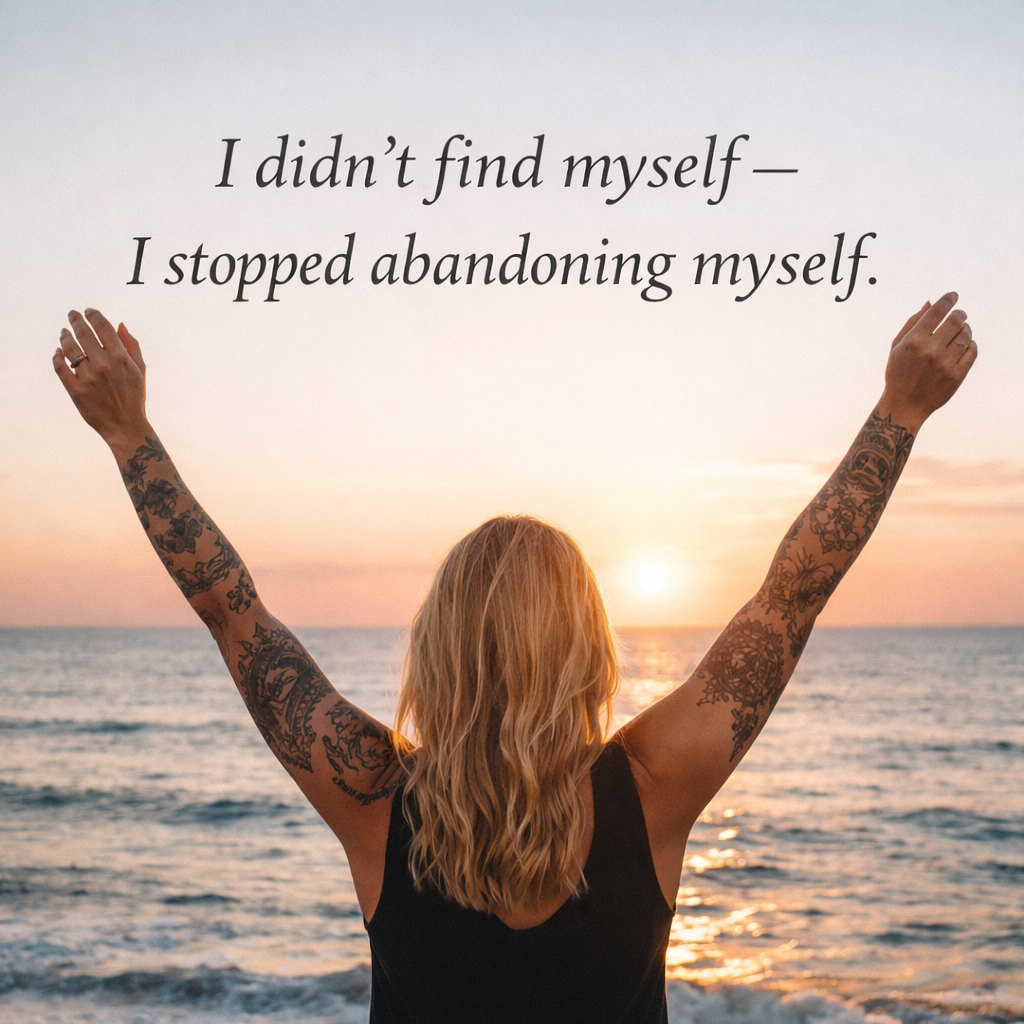
    I Didn’t Find Myself — I Stopped Abandoning Myself

    For a long time, I thought I was searching for myself.

    I said it casually — “I just need to figure myself out.”
    As if I was lost somewhere outside of me, waiting to be discovered once I worked hard enough or got things right.

    The truth is harder and simpler than that.

    I wasn’t lost.
    I was leaving myself — quietly, repeatedly, and with good intentions.

    Every time I ignored my body.
    Every time I stayed silent to keep the peace.
    Every time I chose what made sense over what felt true.

    None of it was dramatic.
    That’s what made it easy to miss.

    Abandonment doesn’t always look like walking away. Sometimes it looks like staying — staying busy, staying agreeable, staying functional — while slowly disconnecting from yourself.

    Coming back to myself didn’t happen all at once. It wasn’t a moment of clarity or confidence. It was a series of small, honest choices: listening when something felt off, resting without justification, allowing myself to change without explaining why.

    I didn’t become someone new.

    I remembered who I was before survival taught me to disappear.

    This is what living looks like now — not perfect, not always easy, but honest. I still feel fear. I still doubt myself sometimes. The difference is, I don’t abandon myself when those feelings show up.

    And that’s the work.

    Not chasing.
    Not fixing.
    Not becoming.

    Returning.

    If you’ve been walking this path alongside me through this post, I hope you’ve felt less alone. And if you’re just arriving here, know this:

    You don’t need to find yourself.

    You’re already here.